Rim repair: The Real Risk of “Minor” Curb Rash on an EV
Most curb rash is cosmetic and can be ignored. But if your EV’s rim is cracked, bent, or leaking air, repair is only safe when done by a qualified shop—and the higher curb weight and instant torque of an EV mean even minor damage can turn into a safety issue faster than you’d expect. Here’s how to separate simple scuffs from real problems, and what you can safely do yourself.
The Real Risk of “Minor” Curb Rash on an EV
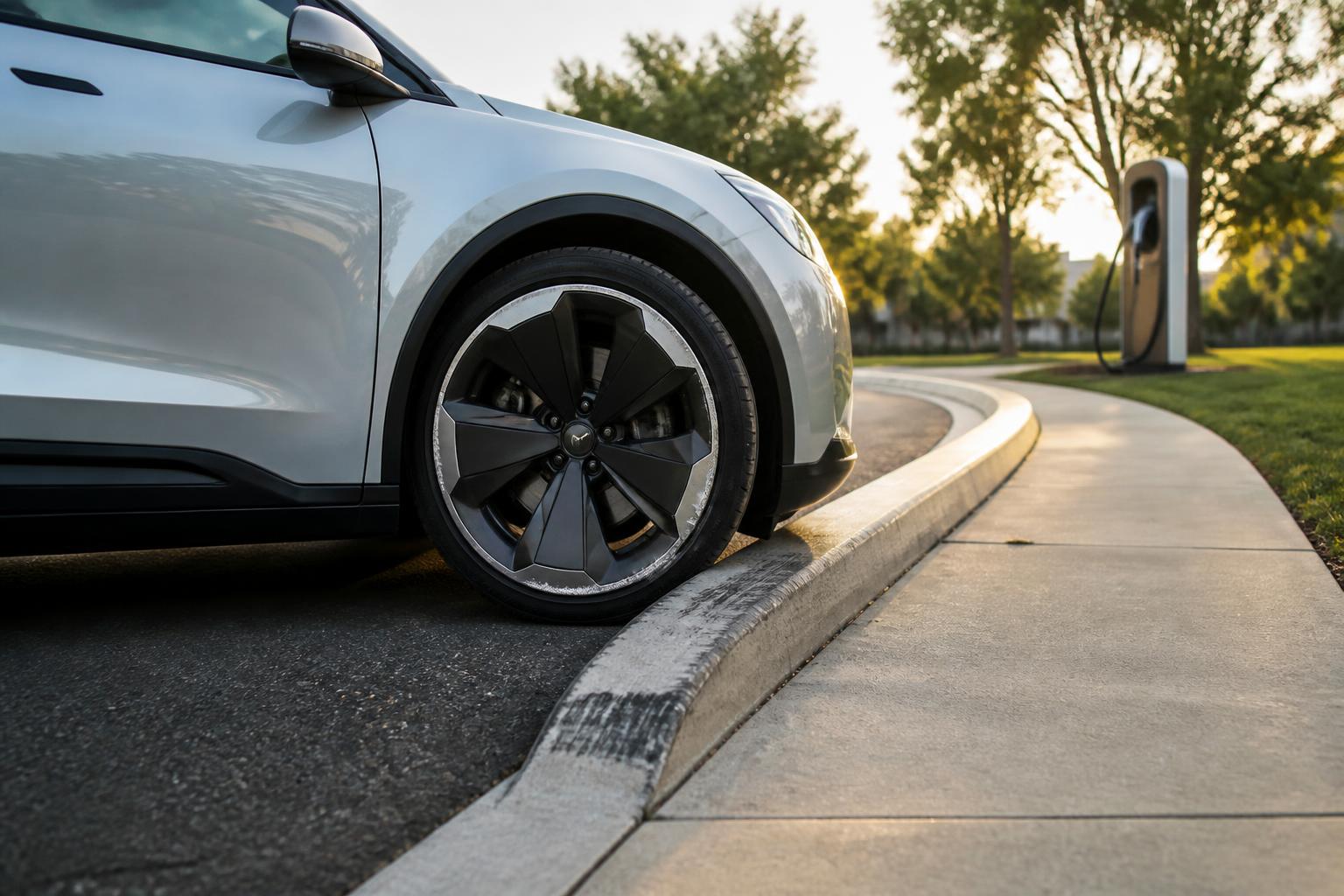
Most generic articles tell you curb rash is harmless. For an EV, that advice misses a critical detail: the extra 800–1,200 pounds from the battery pack, combined with instant torque from the motor, puts repeated stress on the rim’s lip. A scrape that’s deep enough to create a sharp edge becomes a stress riser. Over several thousand miles—especially during regen braking, which loads the rim in a different direction than a gas engine—that stress riser can grow into a hairline crack.
The practical implication: If you hit a curb and the scrape feels rough to the touch or shows exposed metal, don’t just paint over it and forget it. A shop should inspect the lip with a dye penetrant or magnifying glass at your next tire rotation. Ignoring it could mean buying a new wheel later—or dealing with sudden air loss on the highway.
Why Cosmetic Damage Matters More on EVs
The scrape itself doesn’t weaken the wheel. But the edge left behind acts like a notch. On a lighter gas car, the lip flexes less, so the notch rarely propagates. On a heavy EV that corners harder under regen, the repeated flex concentrates at that sharp edge. Over 10,000–20,000 miles, what started as a cosmetic scratch can become a crack that starts at the lip and works inward.

Applicability boundary: This risk is highest on cast aluminum wheels common in entry-level EVs (e.g., base Model 3, Chevy Bolt, Nissan Leaf). Forged or flow-formed wheels—found on higher-trim EVs like the Model 3 Performance or Porsche Taycan—have a denser grain structure that resists cracking better. If you own a forged wheel, cosmetic curb rash is still cosmetic. If you own a cast wheel, treat deep scrapes as a structural concern.
Cosmetic Damage vs. Structural Damage on an EV
Understanding the line between fixable at home and requiring a pro is the most important skill for an EV owner.
Cosmetic Damage (Curb Rash, Light Scuffs)
Surface scratches that don’t expose bare metal and don’t affect the bead seat are cosmetic. On an EV, cosmetic damage alone won’t affect range, handling, or tire wear. You can sand, fill, prime, and paint these at home.
Concrete verification step: After cleaning the area, run a fingernail across the scratch. If your nail catches or the scratch feels deeper than the thickness of a dime, you’re into structural territory. Also check the inner lip—cosmetic damage on the outer face is one thing; the same scrape on the bead seat (where the tire seals) can cause a slow leak that won’t show up until you’ve lost 10 psi.
Structural Damage (Bends, Cracks, Air Leaks)
Any visible crack, a bend deeper than about 1/8 inch, or a wheel that wobbles when spinning means the rim is compromised. Bends from potholes are the most common structural issue on EVs—the extra weight means the suspension is already compressed, so the wheel takes more of the impact.
Realistic mismatch/trade-off: Some shops claim they can straighten any bent alloy wheel. That’s not always safe for EV wheels. The straightening process heats and re-forms the metal, which can create micro-fractures that aren’t visible. On a heavy EV, those micro-fractures can grow over time. If the bend is in the load-bearing spoke area or the inner barrel near the hub, replacement is safer than repair—even if the shop says they can fix it. Check your owner’s manual for the wheel’s load rating; if the bend is near a spoke, assume the rating is compromised.
How to Inspect Your EV’s Rim at Home
Perform these checks in order. Stop immediately at any checkpoint that signals serious damage.
Before you start: You’ll need a jack, jack stands, a spray bottle with dish soap and water, a straightedge, and a magnifying glass. If you have a dial indicator, keep it handy. The car should be on level ground and the parking brake set.
1. Clean the rim thoroughly. Use a degreaser and soft brush. Dirt and brake dust hide cracks, especially on the inner lip.
2. Run your fingers along both lips. Any jagged edge or line that follows the metal grain is a crack. Use a magnifying glass to confirm.
- Checkpoint: If you find any crack—even hairline—stop. Do not drive. Call a rim repair shop. A crack on an EV wheel can propagate under regen forces within a single commute.
3. Spray the bead seat and valve stem with soapy water. Bubbles mean a leak. If the leak is at the valve stem, the TPMS gasket may be the issue, not the rim itself. Replace the gasket first; if the leak persists, the rim’s sealing surface is damaged.
4. Jack up the wheel and spin it. Watch the outer edge for wobble. Use a straightedge held against the rim as a guide. A wobble greater than about 1/8 inch means a bend.
- Likely cause on EVs: Sharp pothole edges. The heavy battery means the suspension doesn’t absorb as much, transferring more force to the rim.
5. Measure runout with a dial indicator (if available). Place the indicator against the inner barrel near the bead seat. Max radial runout for most alloy wheels is 0.050 inches. Higher than that means the rim is bent.
If you pass all five checks with no cracks, leaks, or wobble, the damage is cosmetic.
The Practical Implication of Your Results
- Passed all checks: Safe to DIY repair the cosmetic damage. No need to worry about range or handling.
- Found a bend between 1/16 and 1/8 inch: A shop can straighten it if the bend is on the barrel, not the spokes. Cost typically $100–$200. Replacement is $400–$1,000+ for OEM EV wheels.
- Found a crack or bend deeper than 1/8 inch: Replace the wheel. Straightening a deep bend on a cast EV wheel risks creating micro-fractures that fail later. Do not drive unless unavoidable.
DIY Rim Repair: What You Can Safely Do
Only attempt repairs on purely cosmetic damage—scratches that haven’t weakened the metal and don’t affect the bead seat.
The Cosmetic-Only Rule
If the damage passes the fingernail test and the soapy water leak test, you can repair it at home. Here’s the process:
- Sand the area with 220-grit sandpaper, then 400-grit, until smooth. Feather the edges so the paint doesn’t create a raised lip.
- Clean with isopropyl alcohol and let dry completely.
- Apply a wheel-specific filler (e.g., two-part epoxy putty) if the scratch is deep enough to leave a groove. Let it cure per the manufacturer’s instructions.
- Prime and paint with a color-matched wheel paint. Most EV manufacturers sell touch-up paint in aerosol cans that match factory wheel finishes.
- Finish with a clear coat to protect against corrosion and curb rash recurrence.
Concrete verification step: After painting, let the wheel sit for 24 hours. Then recheck the bead seat area with soapy water. Even cosmetic repairs can warp the metal if you sand too aggressively near the tire seal. If you see bubbles, you’ve damaged the sealing surface and need a pro to reseat the tire after re-machining the lip.
Real Mismatch: When a Plug Kit Won’t Work
If you’re tempted to use a GRAND PITSTOP 20 Pcs Tubeless Tire Puncture Repair Kit with Mushroom Plug or a similar tire plug kit to seal a rim leak, stop. Tire plugs are designed for punctures in the tread area, not rim damage. Using a plug on a rim bead leak will fail under the higher tire pressures common on EVs (42–45 psi on many models). The plug will push out, causing sudden air loss. If the leak is at the rim, the only safe fix is a professional bead seal service or rim replacement.
When It’s Time for a Professional Rim Repair
Escalate to a rim repair specialist if any of the following apply:
- Crack in the rim – even a hairline crack near the lug holes or spokes. On an EV, this means replacement, not weld repair. Welds near the load-bearing area can fail under regen torque.
- Bend deeper than 1/8 inch – or any bend that causes a vibration while driving, even at low speeds.
- Air leak from the rim itself – confirmed by soapy water on the bead seat, not the valve stem.
- Vibration at highway speeds – after ruling out tire balance and alignment. If the vibration disappears when you switch to a spare wheel, the rim is bent.
- Damage to the load-bearing area – spokes, inner barrel near the hub, or the area around the lug nuts. These zones directly support the EV’s weight. If the damage is there, replace the wheel.
EV-specific warning: Some rim repair shops offer “cold straightening” that avoids heating the metal. This is safer than hot straightening for EV wheels, but still risks micro-fractures in cast wheels. If your wheel is cast aluminum (most EV base trims), replacement is the safer long-term choice. For forged wheels, cold straightening by a certified specialist is generally acceptable.
Rim Repair Decision Checklist
Use this quick checklist to decide your next step after any rim impact:
- [ ] Damage is only surface-level (no deep gouges or exposed metal scratches that catch a fingernail)
- [ ] No cracks visible with a magnifying glass, especially on the inner lip and bead seat
- [ ] Tire holds steady air pressure for 24 hours after the impact (check before driving the next day)
- [ ] Wheel spins without wobble when the car is jacked up (use a straightedge as reference)
- [ ] Rim is not bent inward or outward (check with a straightedge placed across two points)
- [ ] TPMS sensor still reads correctly and shows no warning lights
If all six items pass, you’re safe to do a cosmetic repair at home. If any one fails, take the wheel to a professional rim repair shop. Driving on a damaged rim risks sudden air loss, uneven tire wear, and reduced efficiency—especially on an EV where every mile of range counts.

EV owner and automotive writer with 8+ years of hands-on experience across Tesla, Hyundai, Ford, and Nissan EV platforms. Former automotive technician. Certified in high-voltage system safety (Level 2). When not diagnosing charge port faults or testing range in cold weather, I’m helping other EV owners skip the dealer trip and fix problems themselves.