
Agm battery charger: Why Your EV’s 12V Battery Needs an AGM-Charging Profile
An AGM battery charger is a smart charger tuned specifically for Absorbent Glass Mat (AGM) lead-acid batteries. If you own an electric vehicle, your 12V auxiliary battery is almost certainly AGM–it powers the infotainment, lights, door locks, and safety systems when the traction battery is off. A standard flooded charger can push voltage above 14.8V, which vents AGM plates and causes permanent damage. A quality AGM-specific unit costs $30–$100 and delivers 4–10A for maintenance or 15–25A for deep discharges. Most EV owners plug these into a standard 120V garage outlet, so no special electrical service is needed.
Important boundary: This guidance applies to EVs using a traditional 12V AGM auxiliary battery. Some newer EVs (Tesla Model S Plaid, certain Model X trims, and some high-end European models) now ship with a lithium-ion auxiliary battery. Those require a different charging profile–use a dedicated lithium-ion charger with CC/CV algorithm. Always check the battery label to confirm chemistry before selecting a charger.
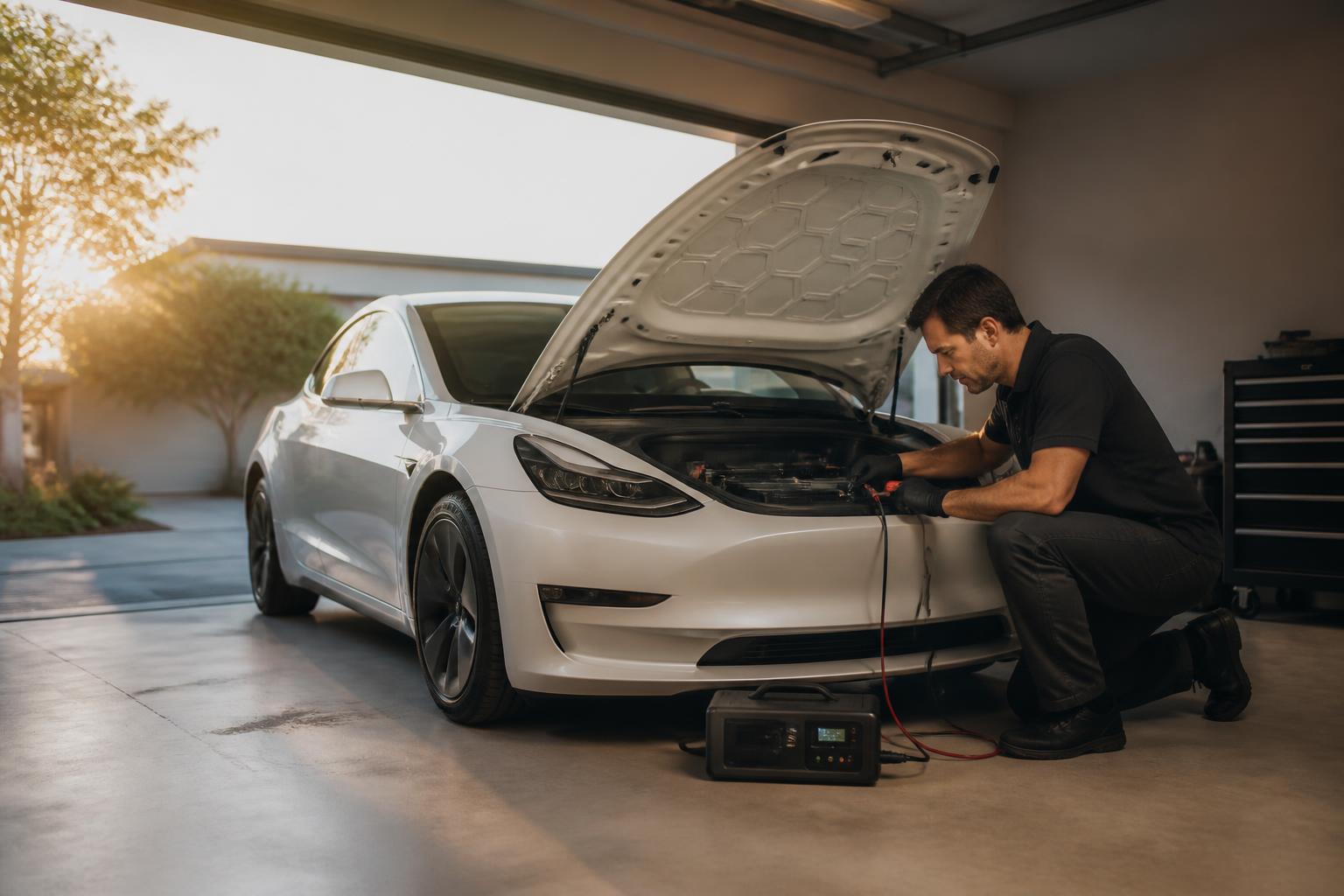
Why Your EV’s 12V Battery Needs an AGM-Charging Profile
AGM batteries have lower internal resistance and tighter voltage tolerance than flooded lead-acid. Most modern EVs–Tesla Model 3/Y, Chevrolet Bolt, Nissan Leaf, Hyundai Ioniq 5–ship with AGM from the factory. Plugging a generic charger into one is a fast way to wreck it.
What an AGM charger does differently:
- Limits absorption voltage to 14.4–14.6V (vs. 14.8V+ for flooded)
- Uses a multi-stage algorithm: bulk → absorption → float → desulfation
- Switches to float at 13.2–13.4V instead of 13.6V
Key specs to verify before buying:
- Rated output current – 4–10A handles maintenance; 15–25A recovers deeply discharged batteries faster. For a typical 40–60Ah auxiliary battery, stay at or under 25% of the battery’s C20 capacity.
- Voltage selection – 12V for passenger EVs; 24V for heavy-duty trucks or vans.
- Charging stages – At least 4 stages including a desulfation/repair mode. Units like the 25A Battery Charger offer 8-stage algorithms with adjustable current (2A, 8A, 20A, 25A), giving flexibility for both maintenance and full recovery.
- Safety certifications – UL or ETL listing for US/Canada.
How to Charge an AGM Battery in an EV
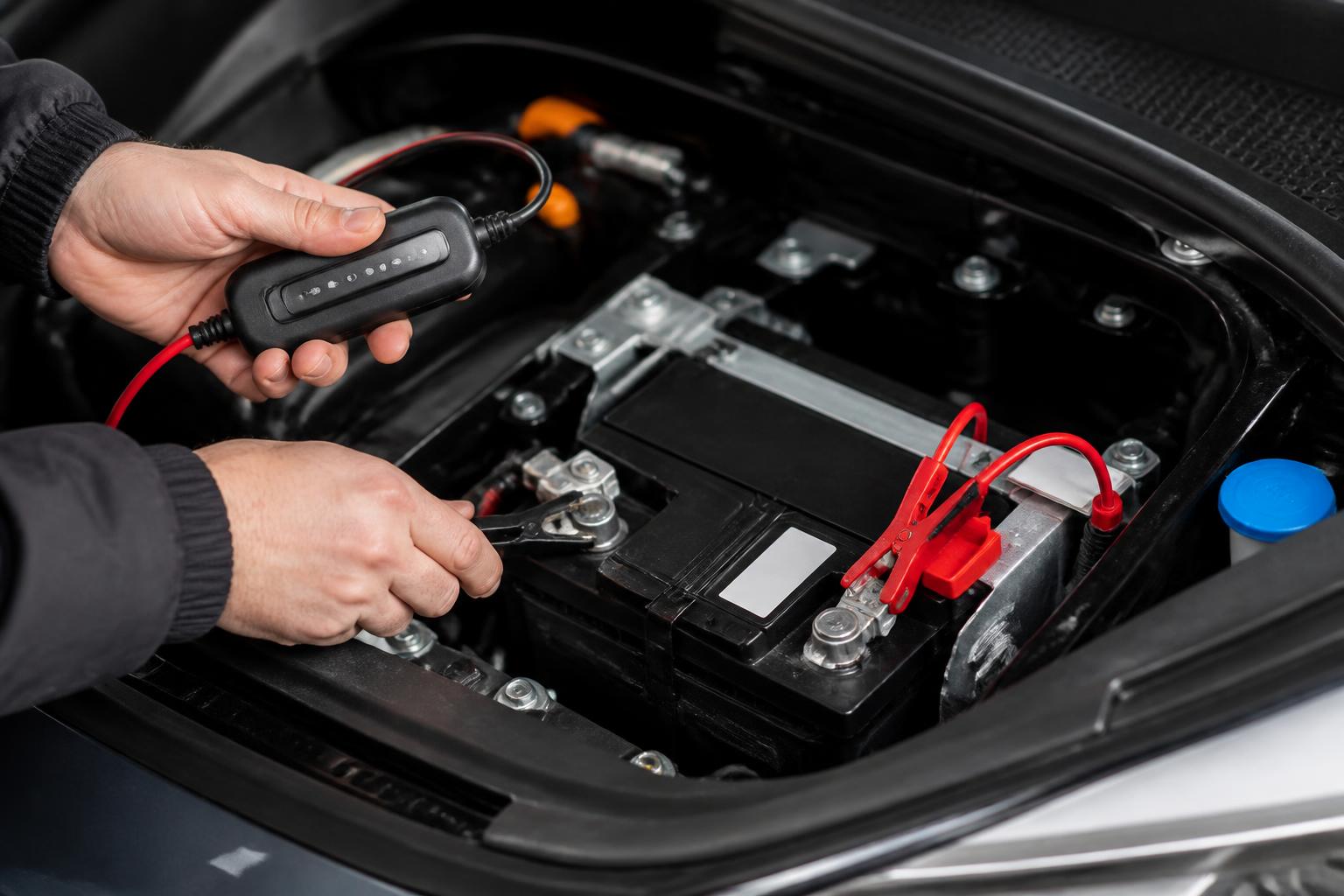
1. Locate the 12V battery – In most EVs it sits under the hood (frunk) or under the rear seat. Tesla Model 3 places it behind the front passenger wheel well liner; Chevrolet Bolt puts it in the trunk area. Check your owner’s manual–some models require removing plastic covers or trim panels.
2. Connect the charger – Attach the red clamp to the positive terminal. Connect the black clamp to a clean chassis ground point (not the negative terminal) to avoid waking the vehicle’s electrical system prematurely.
3. Select the AGM mode – On smart chargers, press the mode button until AGM or AGM/FLD appears. Some units auto-detect, but manual selection eliminates guesswork. If the charger lacks a dedicated AGM setting, do not use it.
4. Monitor the charge – A fully depleted 40Ah AGM takes about 8 hours on 5A or roughly 2 hours on 20A. The charger will drop to float mode once voltage stabilizes at 13.2–13.4V.
5. Disconnect after float stabilizes – If the charger includes a dedicated maintenance mode (trickle output <1A), you can leave it connected for weeks. Otherwise, unplug once float is steady to avoid slow plate corrosion.
**Practical implication for your next decision:** If you plan to store the EV for more than two weeks or leave it parked with a depleted 12V battery, buy a charger with a true float-mode maintainer. This prevents sulfation and avoids needing to jump-start the 12V system later. Chargers that cycle back to a high-voltage absorption phase every 24 hours (common in cheap “automatic” units) will slowly degrade the AGM over a month of continuous connection.
Common Failure Mode: “Unable to Rate” or “Low Voltage” Error
This is the most frequent issue EV owners hit when trying to charge a deeply discharged 12V AGM. The charger’s sensing circuit cannot compute a reliable state of charge when the battery voltage is below ~12.0V (deep discharge) or above ~12.8V (surface charge from recent driving or charging). Many smart chargers simply throw an error and refuse to start.
How to detect it early:
- Measure open-circuit voltage with a multimeter before connecting the charger.
- If reading is below 11.8V, the battery may be sulfated. Run a desulfation/repair cycle first–most multi-stage chargers include this.
- If reading is above 12.6V, let the battery rest for 30 minutes to dissipate surface charge, then re-test.
- If the tester repeatedly shows “unable to rate,” the battery may have an internal cell fault. A load test (available at most auto parts stores) will confirm.
Caveat: Replacing a battery without checking the charging system guarantees repeat failure. A failed DC-DC converter or parasitic draw will kill a new AGM in weeks. Always verify the vehicle’s 12V charging circuit (often the DC-DC converter in an EV) before swapping the battery.
Expert Tips for AGM Battery Care
- Tip 1: Use temperature compensation when available. AGM voltage tolerance shifts with temperature. Many chargers adjust float voltage by approximately -0.003V per °F above 77°F. If your charger lacks this feature, avoid charging in extreme cold (below 20°F) or heat (above 100°F) to prevent over- or undercharging.
Common mistake: Leaving the charger in “storage” mode at 13.6V indefinitely. AGMs should float at 13.2–13.4V. Higher float voltage slowly corrodes the positive plates and reduces cycle life.
- Tip 2: Check the vehicle BMS error codes before charging. Some EVs–especially Tesla Model S and X–flag a “12V battery low” warning even when the battery tests fine on a bench charger. Use a diagnostic tool or the vehicle’s service menu to confirm the charger is actually needed before pulling the battery.
Common mistake: Assuming a dead 12V battery means the traction battery is also dead. They are separate systems. A jump-starter or AGM charger will not charge the main HV pack.
- Tip 3: For PHEV owners, run the engine in Mountain/Save mode periodically. This keeps the 12V battery under active load and prevents the BMS from flagging a low-voltage lockout (threshold #96 on some platforms). If you drive exclusively in EV mode for weeks, the 12V battery can drop below the threshold and trigger a system error that requires dealer intervention.
Common mistake: Ignoring repeated 12V warnings and just charging the battery. The underlying issue–insufficient load from the DC-DC converter–won’t fix itself.
A Realistic Trade-Off: High-Current Chargers vs. Battery Life
A 20-amp or 25-amp charger (like the 20-Amp Car Battery Charger) can fully recover a depleted 40Ah AGM in under 2 hours. That speed is useful when you’re about to drive and the 12V battery is dead. But repeatedly charging at >15A on a small auxiliary battery (40Ah or less) generates more internal heat and accelerates grid corrosion.
For routine maintenance (topping off a battery that is 70%+ charged), stick with 4–6A. Reserve high-current mode for emergencies or when the battery is below 30% state of charge. If you primarily need a maintainer, the Car Battery Charger, 12V 6A Smart Battery Trickle Charger is a safer everyday choice.
Quick Decision Checklist for Buying an AGM Battery Charger
Run through these checks before purchasing or plugging in:
- [ ] AGM explicitly listed as a supported battery type (not just “lead-acid”). Shared lead-acid profiles are not safe.
- [ ] Absorption voltage specified at 14.4–14.6V in the charger’s documentation. No spec means skip it.
- [ ] Rated current ≤ 25% of battery capacity (e.g., for a 50Ah battery, use ≤ 12.5A). Oversizing current on small auxiliary batteries risks overheating.
- [ ] Reverse polarity protection and spark-proof circuitry included. Essential for safe connection in tight engine bays.
- [ ] Desulfation or repair mode available. This cycle can recover mildly sulfated batteries and save you a replacement.
- [ ] Clip leads reach the battery location without extension cords. Measure the distance from battery to nearest outlet before buying.
- [ ] UL or ETL listed for US/Canada. Unlisted chargers may lack proper overcurrent protection.
FAQ
Can I use a standard car battery charger on an AGM battery?
Only if the charger has a selectable AGM profile. Many smart chargers–including the Car Battery Charger, 12V 6A Smart Battery Trickle Charger–offer a dedicated AGM mode. Using a standard charger at 14.8V+ will gas and vent the AGM, causing permanent capacity loss within a few cycles.
How long does it take to charge a depleted 12V AGM in an EV?
At 5A, a 40Ah battery takes roughly 8 hours from 50% state of charge. At 20A (like the 20-Amp Car Battery Charger), it drops to about 2 hours. Charging above 25A on batteries under 60Ah is not recommended.
Can I leave the charger connected indefinitely?
Yes, if the charger has a true float mode at 13.2V with output below 1A. Many smart chargers call this “maintain” mode. Cheap units that cycle back to high-voltage absorption will slowly degrade the battery over weeks.
How do I know if my EV’s 12V battery is AGM or flooded?
Check the label on the battery case. AGM batteries are sealed with no removable caps. If there are vent caps or water-fill ports, it is flooded. Most modern EVs from Tesla, GM, Ford, Hyundai, and Kia use AGM for the auxiliary battery.

EV owner and automotive writer with 8+ years of hands-on experience across Tesla, Hyundai, Ford, and Nissan EV platforms. Former automotive technician. Certified in high-voltage system safety (Level 2). When not diagnosing charge port faults or testing range in cold weather, I’m helping other EV owners skip the dealer trip and fix problems themselves.