
Battery charger with trickle charge: Charging Speed & Time Explained
Trickle charging through a standard 120V household outlet adds roughly 3–5 miles of range per hour. For a fully depleted 60 kWh battery (about 220–250 miles of range), a full 0–100% charge takes 40–60 hours. That sounds slow, but for a daily commute of 30–40 miles, a 10-hour overnight session recovers exactly what you used. Trickle charging is also the most battery-friendly option because it generates minimal heat and stress on the pack.
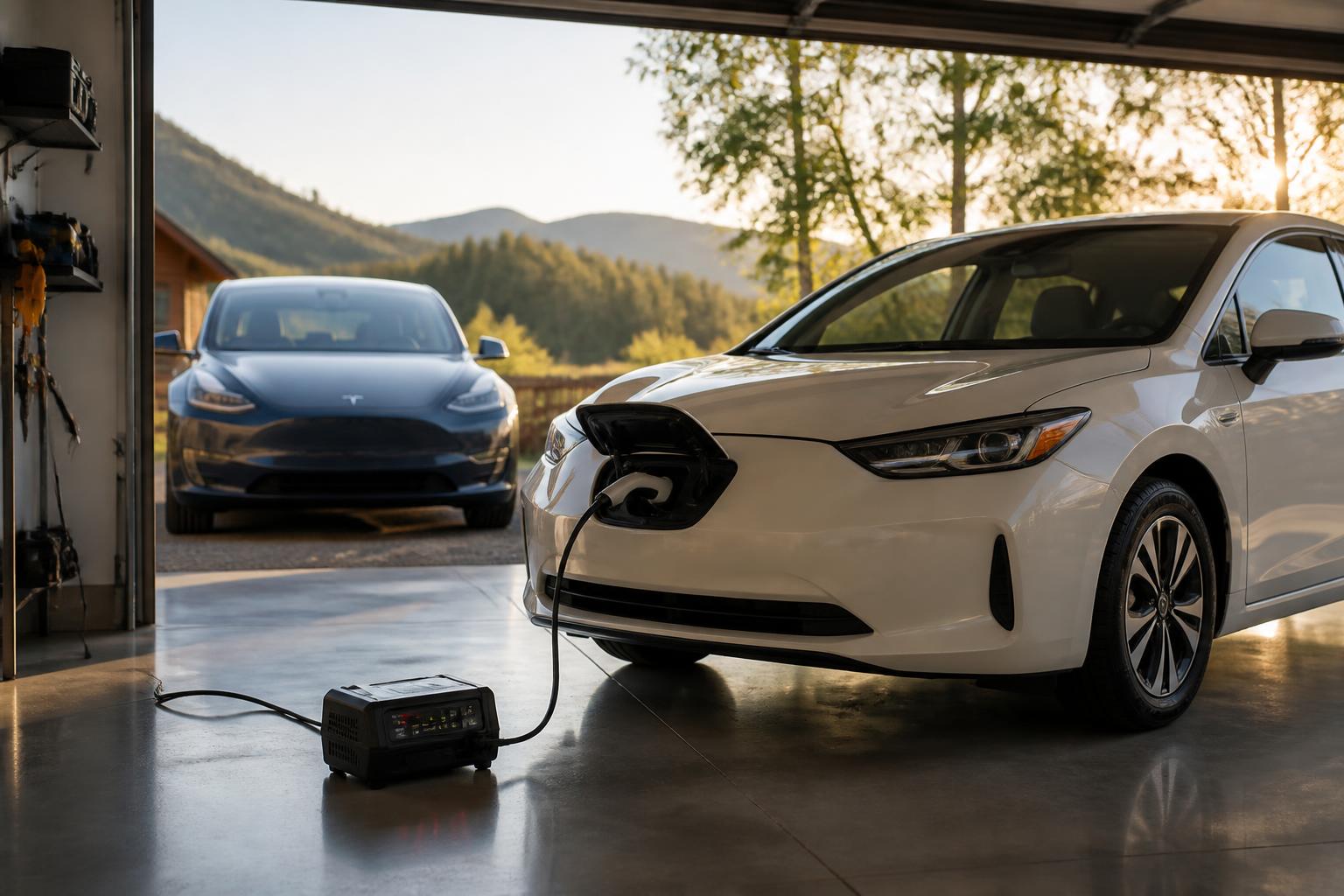
How Fast Is Trickle Charging for Common EVs?
Speeds depend on the vehicle’s onboard charger efficiency and the actual voltage available. These are real-world numbers at a standard 12A, 120V circuit (typical for a Level 1 cord set):
| EV Model | Battery Size (usable) | Miles Per Hour Charging | Time for 0–100% |
|---|---|---|---|
| Tesla Model 3 RWD | 57.5 kWh | ~4 mi/hr | ~50 hr |
| Chevy Bolt EV | 64 kWh | ~4 mi/hr | ~55 hr |
| Nissan Leaf (40 kWh) | 36 kWh | ~4 mi/hr | ~31 hr |
| Ford Mustang Mach-E (Standard Range) | 68 kWh | ~3.5 mi/hr | ~60 hr |
Your actual rate drops if the outlet shares a circuit with other devices or if the car defaults to 8A in “safer” mode. A shared garage outlet can easily cut your charge speed by 25–40%.
Why 80–100% Takes Twice as Long, Even at Trickle Rate
The charging curve applies to AC charging too. Once the battery reaches about 80% state of charge (SOC), the vehicle’s battery management system reduces power to balance cells and protect longevity. On a Level 1 charger, the last 20% can take as long as the first 60%. For daily use, set your charge limit to 80–90% — it saves hours and improves battery life. Only charge to 100% when you genuinely need the full range for a road trip.
Setting Up Trickle Charging: An Operator Flow
Early Checkpoints
Before plugging in, verify your outlet can handle continuous 12A draw. Most garage outlets share a circuit with lights, a freezer, or a power tool. To test: plug in a space heater rated at 1500W and let it run for 30 minutes. If the breaker trips, your outlet can’t sustain a 12A charge session.
Check the outlet temperature after 30 minutes of charging. If it feels hot to the touch, stop charging and have an electrician inspect the wiring. A hot outlet means loose connections or undersized wiring — both fire hazards.
Ordered Steps
1. Plug in the vehicle connector first, then plug the wall brick into the outlet. The car’s charge port light should indicate connection within 10 seconds.
2. Set your target charge limit to 80% for daily use in the vehicle’s charging menu. This avoids the hours-long taper above 80%.
3. Schedule departure time if supported. Enter your morning leave time in the app. The car will time charging to finish just before departure and may preheat the battery using grid power in cold weather.
4. Check voltage during charging through your vehicle’s app or dash display. A voltage reading below 110V under load indicates a weak circuit that will slow charging and may cause intermittent stops.
Likely Friction Points
- Breaker trips after 1–2 hours: The circuit is shared or undersized. Drop to 8A in the car’s settings or find a dedicated outlet.
- “Charging Interrupted” error: Usually a loose 120V plug connection or a GFCI that tripped overnight. Reseat the wall plug firmly.
- Zero miles gained after 8 hours: Some early EVs will not charge below 32°F or 40°F without a battery heater. Check your owner’s manual for the minimum charging temperature.
Success Check
After a full night, your battery should have gained within 5% of the calculated rate (miles per hour × hours plugged in). If you expected 40 miles but only gained 20, the circuit likely shares a load — test during off-peak hours.
What This Means for Your Daily Charging Setup
Here’s the practical decision: if your daily commute is under 50 miles and your garage has a dedicated 120V outlet that doesn’t trip, trickle charging works as a primary solution. You save the $500–1,500 installation cost of a Level 2 station.
But here’s the trade-off most owners miss: trickle charging on a shared circuit can cause your EV to throw a “Low Voltage” or “Unable to Rate” error. That’s not a car fault — the voltage sagged below 108V because the circuit was loaded. If you see these errors regularly, you have two choices: install a dedicated Level 1 circuit (simpler and cheaper than Level 2) or upgrade to a 240V station.
How to Verify Fit on Your Actual Machine
Check your vehicle’s charging settings menu for a “charging current” or “amp” slider. If it shows 12A as the default but you can drop it to 8A, your car can adapt to weaker circuits. If the menu only shows 12A (some older Leafs and Bolts), you must ensure your outlet truly supports continuous 12A draw.
Factors That Make Trickle Charging Slower
- Cold battery: Below 32°F, your EV may divert incoming power to heat the battery before accepting full current. Expect a 25–50% speed reduction until the pack warms. Preconditioning while plugged in helps significantly.
- Shared circuits: A garage outlet on the same breaker as lights, a freezer, or power tools will drop your available amperage. Test by running all typical loads simultaneously and then starting a charge.
- Long, thin extension cords: Using a 50-foot 16-gauge cord can cause voltage sag that cuts charge speed by 20%. Stick to heavy-duty 12-gauge cords for any extension. Better yet, don’t use an extension cord at all.
- High starting SOC: Starting a trickle charge at 90% means almost the whole session happens in the reduced-power taper zone. You’ll get fewer miles per hour compared to starting at 50%.
Expert Tips for Trickle Charging Your EV
Tip 1: Set a daily charge limit, not a full one.
Action: In your car’s menu, set the limit to 80% for daily use.
Common mistake: Leaving it at 100% every night forces the battery to sit at high voltage, accelerating degradation and wasting 2–4 hours of charging time every night.
Tip 2: Use scheduled departure to warm the battery in winter.
Action: Program your departure time in the app. The car will time the charge to finish just before you leave and may preheat the battery using grid power, improving range and regenerative braking.
Common mistake: Expecting full range immediately in cold weather without preconditioning — you’ll lose 10–20% of your range on the first trip and have reduced regen until the battery warms.
Tip 3: Test your outlet’s actual capacity before making it your sole charging solution.
Action: Run a high-wattage device (space heater or hair dryer) on the same circuit for one hour. If the breaker doesn’t trip, your outlet can likely handle 12A continuous.
Common mistake: Assuming any garage outlet can handle 12A continuous draw — most are shared with other outlets and will trip after a few hours. A single tripped breaker overnight means you wake up to a dead car.
AC vs DC Charging: When Trickle Isn’t Enough
A quick comparison to Level 2 (240V) and DC fast charging helps you decide which suits your daily life.
| Charging Type | Power Output | Miles per Hour | Best For |
|---|---|---|---|
| Level 1 (trickle) | 1.2–1.8 kW | 3–5 mi/hr | Overnight top-up for short commutes under 50 miles |
| Level 2 (home or public) | 7.2–11.5 kW | 20–35 mi/hr | Full recharge in 4–8 hours for any commute |
| DC Fast Charging (e.g., Supercharger) | 50–250 kW | 200–1,000 mi/hr* | Road trips, rapid top-ups when arriving at 10–20% SOC |
*DC fast charging rates taper significantly above 80% SOC. Plan your stop to arrive at 10–20% and leave at 60–80% for the fastest session.
Preconditioning: The Trickle Charger’s Hidden Benefit
Most drivers think preconditioning only matters at DC fast chargers. But if you trickle charge on a 120V outlet in cold weather, grid power can warm the battery while it’s still plugged in. This cuts the initial efficiency penalty on your first drive and restores full regenerative braking sooner. To activate it, set a departure schedule in your car’s app — the car will draw from the wall to condition the battery before you unplug.
When Trickle Charging Won’t Cut It
If your daily commute exceeds 50 miles, or if you live where temperatures regularly drop below 0°F, a Level 1 charger may not recover enough range overnight. In that case, install a 240V Level 2 station. Trickle charging remains a great backup, but for primary home charging, Level 2 is the practical choice for heavier use.
The one scenario where trickle charging genuinely fails: cold-soaked batteries below 14°F. Many EVs won’t accept charge at all until the pack warms, and a 120V outlet lacks the power to heat the battery quickly. If you drive a Kona EV, Bolt, or older Leaf and park outside, this is a real winter risk. A 240V Level 2 charger with battery heating support avoids this entirely.
For most EV owners, a simple 120V trickle charger handles the daily grind perfectly — as long as you plan around its speed, use a dedicated outlet, verify the circuit can handle continuous load, and keep your battery between 20% and 80% for everyday driving. It’s the slowest option, but it’s also the most battery-friendly and the cheapest to start using tonight.

EV owner and automotive writer with 8+ years of hands-on experience across Tesla, Hyundai, Ford, and Nissan EV platforms. Former automotive technician. Certified in high-voltage system safety (Level 2). When not diagnosing charge port faults or testing range in cold weather, I’m helping other EV owners skip the dealer trip and fix problems themselves.